I want to show you how microservices are built in real life.
Not the conference-talk version, where three perfectly named services exchange events and nothing ever fails. And not the tutorial version, where the domain is a to-do list and the hard decisions are someone else’s problem. The real version: a business that wants something, a team that has to understand it, decisions that cost money whichever way you take them — and only then the code, the pipelines and the deploys.
What this series is
Over the coming posts I will build a complete system, in public, one brick at a time: a warehouse management system (WMS) — multiple warehouses, cold rooms, batches with expiry dates, deliveries, picking, dispatch. A real domain that real people work in, chosen precisely because it pushes back: it has hard physical rules (“frozen goods only in freezer rooms”), auditors, forklifts, and a business language worth learning.
I will walk the entire professional process, start to finish:
- Domain discovery — talking to the business, event storming, finding the language, being corrected (the most valuable part), and writing down why behind every decision.
- Strategic design — bounded contexts, what becomes a microservice and what deliberately doesn’t, and the trade-offs we pay for each choice.
- Tactical design — aggregates, value objects, archetype patterns, invariants that live in code instead of wiki pages.
- Building the services — .NET 10, Clean Architecture per module, EF Core with a rich domain, the transactional outbox, sagas, API gateway, React frontends for two very different users (a manager at a desk and an operator with a scanner).
- Engineering the delivery — CI pipelines, tests that guard architecture, contract tests between services, security scanning, container builds, deploys, observability — everything that turns “works on my machine” into “runs in production”.
Nothing will be hand-waved. When we add RabbitMQ, you will already know which business fact travels through it and why it must not be lost. When we add a security scan to the pipeline, it will scan code you watched being written.
Who this is for
Developers who are curious what it actually looks like in a professional team — the whole process, end to end. You’ve written services, maybe followed a microservices tutorial or two, and you’re left with the questions tutorials skip:
- How do you know where one service ends and another begins — before it’s too late?
- What do senior engineers actually argue about, and how do those arguments get settled?
- What does “understanding the business” concretely produce, besides meetings?
- What surrounds the code in real delivery — reviews, pipelines, scans, deploys?
If that’s you, welcome.
The rules I’ll hold myself to
- Domain first. The first several posts contain no infrastructure at all. We earn the right to talk about brokers by first understanding what a pallet is.
- Every decision shows its price. No choice is presented as free — each gets an explicit trade-off, including the ones where the “default advice” would say otherwise (yes, we go microservices from day one, and I’ll tell you exactly what that costs).
- A real codebase is the single source of truth. This series isn’t a thought experiment: behind every post there is a real, public repository with the actual code, design docs and diagrams, and the posts describe what was genuinely built. If the code changes, the post gets a changelog note.
- The business stays in the room. Expect yogurt, forklifts and auditors in every post — if a rule can’t be explained with a pallet, it probably shouldn’t be in the code.
The roadmap
Part I — The domain
- Event Storming: modeling a domain on a wall — the colour grammar, the three zoom levels, and why a wall beats a requirements doc
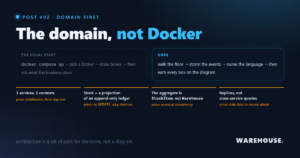
- Why we start with the domain, not with Docker — applying the method, the big picture, strategic decisions, and a one-page DDD building-blocks primer
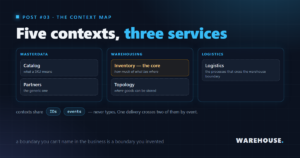
- Five contexts, three services — a guided tour of every bounded context
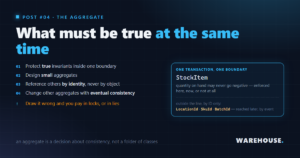
- The aggregate: where to draw the lines — the four rules, how to find the boundary, and what it costs to draw it wrong
- Archetypes: pre-paid modeling decisions — Party/Role, Quantity, the ledger, and their price tags
- The SharedKernel: the most dangerous package — what we share, what we deliberately duplicate
- The “Price Tag” revisited — where the model might creak, admitted up front
- Wrapping up Part I — the retrospective before we touch technology
Part II — From understanding to delivery
Turning the whiteboard into a plan, a design, and then running code. First the plan and design — user story mapping (epics, stories, tasks, the walking skeleton), then the design pass (functional & non-functional requirements, ADRs, Clean Architecture, the diagrams worth keeping, and a first design system for the two frontends). Then we open the IDE and lay the foundations: the seam between the domain and the database — the Repository, the Unit of Work and Domain Events — followed by persisting a rich domain in EF Core 10, Aspire wiring the system into one dotnet run, the transactional outbox, and observability.
Part III — Brick by brick
Features end to end — master data with a React panel, the first integration event, inbound and outbound sagas, handling units, stocktakes — each brick adding one architectural concept. And around it all: CI/CD per service, architecture & contract tests, security scans, deploys.
Let’s start where every real project starts — not with docker compose up, but with a conversation at a wall of sticky notes. That conversation has a name and a method, and it gets the first post of the series: Event Storming: Modeling a Domain on a Wall Before You Write Code.
Bibliography
- Eric Evans — Domain-Driven Design: Tackling Complexity in the Heart of Software (Addison-Wesley) — the book behind the domain-first discipline this series follows
- Sam Newman — Building Microservices (O’Reilly) — the standard reference on service boundaries and the costs of distribution
- Alberto Brandolini — Introducing EventStorming (Leanpub) — the workshop method the whole series starts with; see also eventstorming.com

Leave a Reply