
Michał Kasperczyk
Senior .NET engineer · AI systems for the SDLC
Senior .NET engineer with 15+ years of experience, currently building AI systems that support the SDLC. Six years leading teams; here I write about agent harnesses, verification gates and the architecture behind reliable AI systems.
-

Aggregate: Where You Draw the Lines (and What It Costs to Draw Them Wrong)
DDD aggregate design from first principles: the four rules, how to find the consistency boundary, and what it costs when you draw…
-
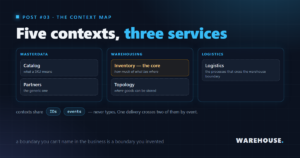
Five Bounded Contexts, Three Services: A Tour of a Warehouse Domain
Bounded contexts in practice: a tour of five contexts mapped to three services, how they talk through events not shared types, and…
-
Writing Agents That Work: opening a field guide from skills to systems
A field guide to building agentic systems — skills, subagents, feedback loops — that separates peer-reviewed evidence from vendor self-report. Sources tagged.
-

From PR to Production: Why We’re Building Forge
Part 1 in the series on building Forge, an agentic SDLC that runs a ticket from a business request all the way…
-

Opening the Forge Series: Design Before Code, Measurement Before Claims
Opening the Forge series on building an agentic SDLC from ticket to production — design before code, and a rule that every…
-
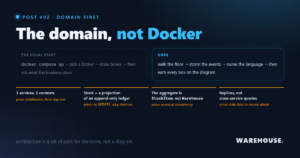
Why We Start With the Domain, Not With Docker
Why domain-driven design starts with the business, not `docker compose up`: the big-picture board, the strategic decisions it surfaced, and the price…
-
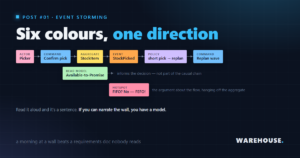
Event Storming: Modeling a Domain on a Wall Before You Write Code
Event Storming explained: the colour grammar, the three zoom levels, and how a wall of sticky notes models a domain before you…
-

How Microservices Are Really Built: A Series
I want to show you how microservices are built in real life. Not the conference-talk version, where three perfectly named services exchange…
-
PostgreSQL vs MSSQL Locking: Architectural Differences and Practical Patterns
Mastering Database Concurrency: From MSSQL Lock Hints to PostgreSQL MVCC.
-
When and How to Use Locking Hints in SQL Server?
In a perfect world, the SQL Server Query Optimizer works perfectly. It automatically decides when to use Shared (S) locks for reading…