Part 2 in the series on building a real microservices warehouse application. Start from the beginning: How Microservices Are Really Built.
Most microservices tutorials start with infrastructure: a compose file, three services named OrderService, PaymentService, NotificationService, and a to-do list to ship. Then the hard questions arrive — where exactly does an “order” end and a “shipment” begin? — and the answer gets duct-taped across HTTP calls.
This series goes the other way. We will build a complete, production-shaped microservices system in .NET 10 — gateway, three services, Postgres-per-service, RabbitMQ, outbox, sagas, React frontends, CI/CD — but the first five posts contain no infrastructure at all. We start where real projects start: with the business.
Why a warehouse?
I wanted a domain that is:
- Real. Warehouses exist; people who work in them will recognize every word we use (ASN, goods receipt, put-away, FEFO, blind stocktake). Nothing is invented for the demo.
- Rich in invariants. “Frozen goods can only sit in a freezer room” is a hard rule with physical consequences — far more interesting than “email must contain @”.
- Naturally distributed. Product master data, physical stock, and logistics processes genuinely change at different speeds and for different reasons. The seams are real, not manufactured to justify microservices.
- Not another e-shop. You have seen enough cart services.
The business brief (after a few conversations with our product owner):
We run several warehouses. Each has rooms — some are regular, some are cold rooms or freezers. Rooms have racks with addressable locations. Products have sizes, weights, types and storage requirements. Suppliers announce deliveries, trucks arrive at docks, goods are received, checked by QC and put away. Customers place orders; we reserve, pick, pack and hand over to carriers. And please — we must always know exactly what is where, because auditors visit twice a year.
That last sentence is the whole project. Everything we build serves one core capability: precise knowledge of what is stored where, and a trustworthy record of how it got there.
A day in the warehouse (developer glasses off)
Before any stickies, let’s just watch the place work. No patterns, no services — people and pallets.
6:10. A truck from a dairy supplier backs up to dock D02. It was announced — the supplier sent an advance notice yesterday (Polish warehouse folk call it awizacja): two pallets of yogurt, one of butter, arriving today between 6 and 7. Because the warehouse knew, dock D02 was free, and Marek was scheduled to receive it. An unannounced truck would be standing in the yard now, waiting for someone to improvise.
6:25. Marek scans pallet by pallet. The yogurt says batch L2406-117, best before July 3rd. He types both in — for food, the batch number is the difference between “recall 2 pallets” and “recall the entire warehouse”. One pallet of butter is missing; the driver shrugs. Marek records a shortage on that line and signs off. The goods are now officially on stock — but physically they sit in the dock buffer, a marked square of floor next to the ramp.
6:40. The system proposes where each pallet should go. Yogurt needs 2–6 °C, so it proposes a rack location in cold room CHLD1 — never the ambient hall, even if the hall is emptier. Forklift driver scans the pallet, drives, scans the rack label, done. That double scan is the whole trick: the system believes scans, not memory.
9:15. The QC inspector doesn’t like the look of the butter batch — temperature logger in the truck showed a spike. She puts the batch on hold. Instantly, every pallet of that batch, in every location, in every warehouse, is frozen for orders. Nobody emails anybody; the hold is the fact.
11:00. A supermarket chain orders 300 yogurts for Thursday. The system makes a soft reservation — it sets aside 300 of this SKU in this warehouse, protecting the promise, but it does not pin a specific pallet yet. That restraint is the whole point: Thursday is two days away, and in two days a particular pallet can be QC-blocked, clipped by a forklift, or moved. Committing concrete stock now would mean re-doing it every time reality shifts. The concrete choice — which batch, which location — waits until the order is released to the floor for picking. Only then does FEFO decide (first-expired, first-out): take the batch dying soonest, re-checking at that moment that it’s still QC-released and unexpired. Fresh stock stays for later orders; the older batch leaves before it becomes waste.
14:30. Picker gets a route: three locations, shortest path. At the second one the shelf says 11, the system says 12. She doesn’t “fix” anything — she reports a short pick, takes the 11, and the system replans the missing piece from another location. And the twelfth yogurt? Here’s the honest part: an unrecorded physical loss is precisely what the ledger cannot contain — that’s why stocktakes exist. What the ledger does give you is every recorded touch of that location, so the search narrows to a window: “correct at last count, three picks and one put-away since”. The truth lands with the next blind count, and its correction enters the ledger like everything else — with a reason, a name and a timestamp.
16:00. Packed, labeled, carrier scans the handover, signs. Stock drops, a tracking number goes to the customer. The day produced ~400 movements, and every single one is a permanent line in the ledger: who, what, from where, to where, when, why.
If you understood this story, you understand 80% of the system we’re about to build. The remaining 20% is making it survive forklifts, concurrency and auditors.
What the business taught us (and what we’d have gotten wrong)
The event-storming session was mostly us being corrected. The corrections are the most valuable artifacts we own — each one killed a wrong model before it was coded:
- “FIFO? No. FEFO. A delivery can arrive with shorter expiry than what’s already on the shelf.” — We’d have modeled first-in-first-out and quietly rotated stock wrong. Expiry lives on the batch, and picking order follows expiry, not receipt date.
- “When QC blocks goods, they block the batch, not a pallet.” — Our first sketch put the quality flag on stock-at-location. Wrong: a suspicious batch is suspicious everywhere at once. That single sentence moved the QC hold onto the
Batchand gave reservations a gate that rejects quarantined, rejected and expired batches. - “During stocktake, counters must not see what the system expects.” — Blind counts. If the screen says 12, people count “12”. Show nothing, and they count what’s there.
- “We never edit a stock number. Ever. We add a correction.” — The warehouse manager said this with the face of someone who once spent a week explaining a missing pallet to an auditor. The append-only ledger is not our idea; it’s how the business already thinks.
- “Temperature is not negotiable. Capacity is.” — If a location is full, the operator scans a neighboring one and life goes on. If a location is too warm for yogurt, there is no override button, and there must not be one. This split — hard rule vs soft preference — shaped the entire put-away design.
- “Half our ‘suppliers’ also buy from us.” — One company, two roles. The
Supplierstable died in that sentence (more on that later in the series).
This is what DDD actually is. Not the folder structure — the conversations. The folder structure just preserves what the conversations taught us.
The big picture — the event-storming board
Before any code, we ran an event-storming session — the workshop technique from the first part of this series, where the business flow goes onto a wall as colour-coded stickies: orange for domain events (facts, past tense), blue for commands, yellow for aggregates that decide, purple for policies (whenever X then Y), green for read models, red/pink for actors and external systems. The whole board does not fit on one screen and never did — it was a wall. So here it is in the four phases the goods themselves move through, left to right in business time within each one:
Inbound: from the ASN to the goods receipt
The flow starts before the truck does. The supplier announces the delivery (an ASN), which creates the InboundDelivery — and when the truck actually shows up, the same aggregate decides again on the goods receipt. The first policy on the board is already an exception: a truck that arrives unannounced does not get waved through, it gets an ad-hoc ASN first.
InboundDelivery appears in both steps because it is the aggregate that decides in both.Quality: the gate that can stop everything
Quality is small on the board and large in its consequences. An inspector blocks or quarantines a Batch, and the policy that follows reaches across the whole warehouse: a blocked batch quarantines its stock everywhere, not just the pallet in front of the inspector.
Batch, and a policy whose blast radius is every StockItem carrying that batch.Storage: the dock buffer and the put-away decision
GoodsReceiptConfirmed hands over to storage, where stock first lands in a dock buffer rather than a final location. The PutAwayPolicy — temperature ∧ capacity ∧ load — is what turns “somewhere in the warehouse” into a specific bin, and every confirmed put-away writes a ledger entry that the stock levels view is projected from.
StockMoved lands as a ledger entry the stock levels view reads from.Outbound: order, allocate, dispatch
Outbound is the longest chain on the board, so it is worth reading in its three beats. An order soft-reserves stock (available-to-promise), releasing a wave allocates it hard against FEFO — re-checking batch quality on the way, because quality can have moved since the reservation — and only then does a picker get a routed pick list to scan against.
StockItem reappearing here — the same aggregate that storage put away.Two things jumped off the board:
- Hot spots cluster around
StockItemand the ledger. Almost every process ends in “stock changed somewhere”. That is our core domain. - The pivotal events are few.
GoodsReceiptConfirmed,StockReserved,ShipmentDispatched— these are the natural integration points between future services.
Classifying the subdomains
Not everything deserves the same investment. The classic core/supporting/generic split:
| Subdomain | Type | Why |
|---|---|---|
| Inventory (stock, movements, reservations) | Core | Accuracy of “what is where” is the business |
| Logistics (inbound/outbound processes) | Core | The flow of goods is the second pillar |
| Product Catalog | Supporting | Necessary, but nobody picks a warehouse for its product cards |
| Warehouse Topology | Supporting | Physical structure; changes rarely |
| Partners (suppliers, customers, carriers) | Generic | The textbook Party problem — solved patterns exist |
| Identity & Access | Generic | Buy, don’t build |
Trade-off: classifying Topology as “supporting” means we accept a simpler model there (one aggregate per warehouse) and spend our complexity budget on Inventory. If this were a slotting-optimization product, Topology would be core and modeled very differently.
The strategic decisions — and what each one cost
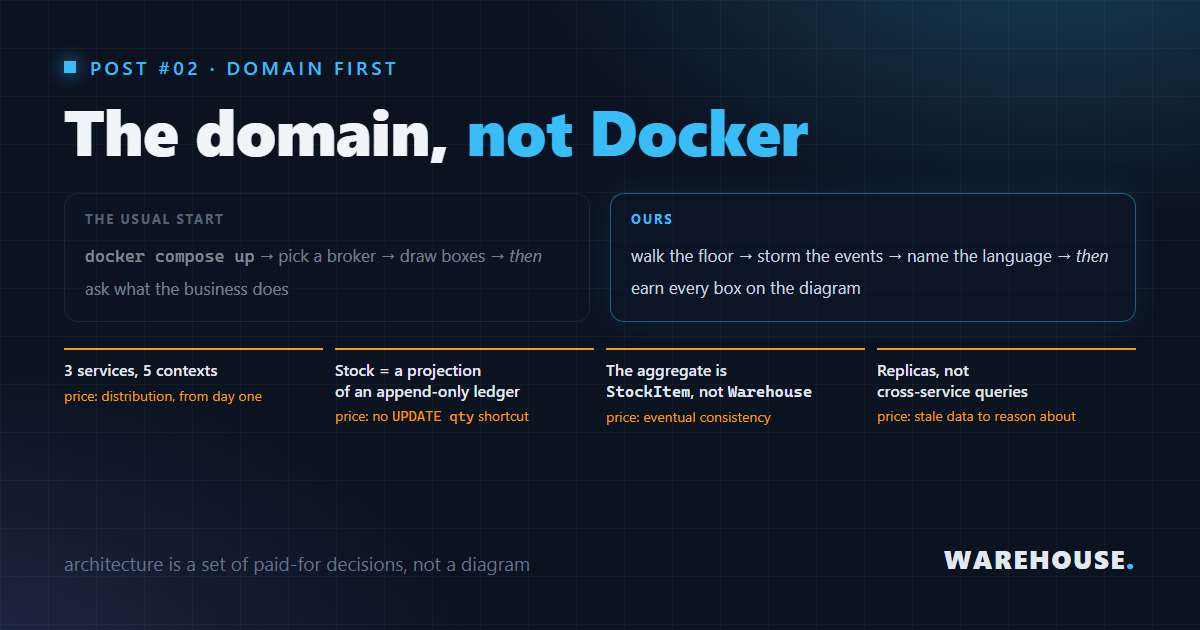
Decision 1: Microservices from day one (3 services, 5 contexts)
The honest default advice for a fresh domain is a modular monolith — boundaries are cheapest to fix when they are just folders. We chose microservices from day one anyway, deliberately: this series exists to show the real mechanics of a distributed system (outbox, sagas, contract tests, independent deploys), and we wanted those constraints present from the first commit, not retrofitted fifteen posts later.
But we did not create five services for five contexts:
| Service | Contexts inside | Why together |
|---|---|---|
warehouse-service | Inventory + Topology | They share hard invariants (capacity, temperature) that must validate in one transaction |
logistics-service | Logistics | Long-running processes, sagas, external integrations |
masterdata-service | Catalog + Partners | Slow-changing, read-mostly reference data |
Inside each service, contexts remain separate modules with separate database schemas — the logical model stays five contexts; only the deployment count is three.
Trade-off: we pay for this choice with eventual consistency between services and with boundary mistakes being expensive (moving a concept across a service boundary is a data migration, not a refactor). We mitigate by keeping contexts as modules — if a boundary is wrong, we move a module, not a tangle of code. And we accept the cost knowingly: it is the subject of the series.
Decision 2: Stock is a projection of an append-only ledger
Every change of stock produces an immutable StockMovement (who, what, from, to, when, why). Current quantities are a projection of movements. Corrections are reversing movements, never edits.
Trade-off: more rows, and the projection must never drift from the ledger (we made that structurally impossible — domain behaviors return the movement to persist, so you cannot change stock without producing a ledger entry). What we bought: a complete audit trail — remember the auditors? — trivially debuggable history, and natural integration events.
Decision 3: The aggregate is StockItem, not Warehouse
A StockItem is the quantity of one SKU (and batch) at one location. Every scan-gun confirmation is a short transaction on one small row.
Trade-off: invariants that span stock items (location capacity across many SKUs) cannot live inside the aggregate — they move to a domain service (
PutAwayPolicy) plus a database constraint as the last line of defense. That is the price of never having a hot row under 40 concurrent forklifts.
Decision 4: Replicas instead of cross-service queries
Inventory needs product storage requirements (Catalog) and room environments (Topology) to validate every put-away. It does not call anyone — it keeps local ProductSnapshot/LocationSnapshot replicas, updated by events.
Trade-off: the replica can be seconds stale. We accept it: product master data changes rarely, and a put-away validated against a 5-second-old temperature requirement is a non-problem. What we bought: put-away works when masterdata-service is down, and there is no temporal coupling between services.
A one-page vocabulary: the building blocks of DDD
So far this post has been about the conversations. But Domain-Driven Design also gives a precise vocabulary for the model those conversations produce — and from the next post on we’ll use it constantly (and, later in the series, write it as C# classes). Here it is in one place, each term tied to something you already met in the story above. Two groups: the strategic words draw the boundaries between parts of the system; the tactical words describe what lives inside one part.
Strategic — carving the system into parts:
- Ubiquitous Language — one agreed word per concept, used by developers and the business, in conversation and in code. “Put-away”, “FEFO”, “dock buffer” aren’t jargon we invented; they’re the warehouse’s own words, and the classes are named after them. When the manager says “we never edit a stock number, we add a correction”, the word correction ends up in the code. (The glossary below is exactly this language, written down.)
- Subdomain — a slice of the business problem, classified core / supporting / generic by how much it deserves our investment (we did this just above). Inventory is core; identity is generic — buy, don’t build.
- Bounded Context — a boundary inside which one model and one language stay consistent. It’s what lets the word “SKU” mean a strictly-validated catalog entry in one context and “whatever the scanner just read” in another — two precise, different meanings, no contradiction. Subdomains are the problem; bounded contexts are our answer to them (the next post walks through all five of ours).
- Context Map — how contexts talk: which events flow where, what’s shared and what’s deliberately not. (We draw ours in the next post.)
- Shared Kernel — the small set of model fragments two or more contexts agree to share and coordinate every change on. Useful and dangerous in equal measure; a later post is entirely about keeping ours tiny.
Tactical — what lives inside one context:
| Building block | What it is | In the warehouse |
|---|---|---|
| Entity | A thing with an identity that persists as its data changes | A Batch is the same batch even as its quantity drops — it has identity, not just values |
| Value Object | A thing defined entirely by its values — immutable, no identity | Quantity(10, Piece), a TemperatureRange, an Address — equal when their values are equal; you replace them, never mutate them |
| Aggregate | A cluster of entities + value objects that must change together, under one rule | StockItem plus the allocations inside it — they stay consistent within a single transaction |
| Aggregate Root | The one entity that is the only door into an aggregate | You call StockItem.Pick(...); you never reach in to edit an allocation directly |
| Invariant | A rule that must always hold | “available-to-promise is never negative”; “frozen goods never in an ambient room” |
| Domain Event | A fact that happened, named in the past tense | GoodsReceiptConfirmed, BatchBlocked — the orange stickies, now code |
| Domain Service | Behavior that spans aggregates and belongs to none of them | PutAwayPolicy checks a StockItem against a Location — neither aggregate can own the rule |
| Repository | The collection-like way to load and save an aggregate, hiding the database | “give me this StockItem, save this Party” — no SQL in the domain |
Two rules of thumb that recur through the series. Value objects are cheap safety — push every concept you can down into an immutable, self-validating value, and whole classes of bug stop being writable (a Quantity that refuses to add kilograms to pieces). And the aggregate is the consistency boundary — choose it by asking “what has to be true within one transaction?”, which is exactly why our aggregate is the tiny StockItem and not the whole Warehouse (decision 3 above).
These are patterns, not law. We bend them on purpose and say when: the append-only ledger borrows from event sourcing without paying its full price (we’ll see it in code later in the series), and some rules live in domain services because forcing them onto an aggregate would lie about the model. The glossary that follows is the other half of the vocabulary — not the patterns, but the domain words themselves.
Ubiquitous Language Glossary (WMS)
This glossary defines the core language shared by the development team and warehouse experts, as established during domain discovery and event storming sessions.
1. Inventory Management
- StockItem: The smallest unit of physical stock tracking, identified by the combination of SKU + Batch + Location.
- StockMovement (The Ledger): An immutable, append-only record of a physical change in stock (who, what, from, to, when, why). Current quantities are a projection of these movements.
- Batch: A group of products with the same production series and expiry date. Quality holds (QC Hold) are applied at the batch level, blocking the stock across all locations simultaneously.
- FEFO (First Expired, First Out): The primary rule for picking; the batch with the nearest expiry date must be shipped first, regardless of when it arrived at the warehouse.
- Blind Stocktake: An inventory counting process where expected quantities are hidden from the operator to ensure an honest and accurate physical count.
- On-Hand: The total physical quantity of goods currently sitting on the shelf.
- Allocated: Quantity hard-pinned to specific customer orders at wave/pick time, awaiting pick.
- Available-to-Promise (ATP): What can still be promised to new orders — On-Hand minus Allocated minus outstanding soft reservations. Zero for stock that is blocked or expired.
- Soft Reservation (
StockReservation): A SKU-level promise made when an order arrives (“300 of this SKU in this warehouse”), protecting available-to-promise without pinning any physical pallet. - Hard Allocation (
Allocation): The concrete commitment made at wave/pick time — a specific batch + location chosen FEFO, with batch quality re-checked at that moment.
2. Logistics & Processes
- ASN (Advance Shipping Notice): A notification sent by a supplier (often called awizacja) announcing an upcoming delivery, including what products are arriving and when.
- Goods Receipt: The process of unloading a truck and confirming that the physical goods match the ASN.
- Dock Buffer: A marked area on the warehouse floor near the loading ramp where received goods “legally” exist in the system after receipt but before they are moved to a final storage location.
- Put-away: The task of moving goods from the receipt buffer to a specific storage location based on hard rules like temperature and capacity.
- Pick: The process of retrieving goods from storage locations to fulfill a customer order.
- Short Pick: A situation where a picker finds less stock on the shelf than the system expected. This is treated as an inventory problem, not a picking error.
3. Warehouse Topology
- WarehouseSite: The highest level of physical structure (referred to as “Warehouse” in business language).
- Location: A stable, addressable physical point (e.g., a specific shelf) identified by a scannable barcode (e.g., WAW1-CHLD1-A-03-2).
- Handling Unit (LPN): A pallet, carton, or container with a unique License Plate Number code. Moving the LPN moves all its contents in a single transaction.
- Cold Room / Freezer: Temperature-controlled zones with hard storage requirements (e.g., yogurt requires 2–6 °C).
4. Master Data & Archetypes
- SKU (Stock Keeping Unit): A unique identifier for a product type. Every context speaks in SKUs, but only the Catalog owns its full definition.
- ProductType (Product Card): The definition of a product, including dimensions, weight, and specific storage requirements.
- Party / Role: An architectural pattern where a single legal entity (Party) can play different roles, such as being both a Supplier and a Customer.
- Quantity: A value object that combines a non-negative numeric amount with a Unit of Measure, ensuring that units (like kilograms and pieces) are never incorrectly mixed.
What’s next
Next we walk through each bounded context — its aggregates, its use cases, and exactly how contexts talk to each other without ever sharing a type.
And to close, the full board once more — the same flow, this time drawn with the exception paths and the stocktake process included:
Bibliography
- Eric Evans — Domain-Driven Design: Tackling Complexity in the Heart of Software (Addison-Wesley) — the origin of subdomains, bounded contexts, aggregates and the Ubiquitous Language this whole post leans on
- Vaughn Vernon — Implementing Domain-Driven Design (Addison-Wesley) — the practical companion for turning strategic DDD into running code, including aggregate design
- Alberto Brandolini — Introducing EventStorming (Leanpub) — the workshop that produced our board; see also eventstorming.com

Leave a Reply