Part 1 in the series How Microservices Are Really Built.
Real projects don’t start with docker compose up — they start with a conversation about the business. This is that conversation, and it has a name and a method: Event Storming. Before we model a single aggregate or argue about service boundaries, we spend a morning at a wall covered in sticky notes, with the people who actually run the warehouse. It is the single highest-leverage thing we do on this whole project — and the cheapest to copy — so it earns the first post.
Everything that follows is downstream of this one. The domain we’ll carve up, the bounded contexts we’ll draw, the archetypes and the ledger — all of it came off a wall, in business language, before any code existed. So let’s understand the technique first, and then watch it pay off.
It’s called Event Storming, invented by Alberto Brandolini around 2013. The pitch is almost insultingly simple: get the people who know the business and the people who’ll build the software in one room, give them a wall and a lot of orange sticky notes, and model what happens — as a flow of events — before anyone opens an IDE. No UML, no boxes-and-lines, no database. Just facts on a wall, argued over until they’re true.
That’s it. The rest of this post is why that works, the grammar that turns a messy wall into a model, and the three zoom levels we used.
Why a wall of stickies beats a meeting
A normal “requirements meeting” produces a document nobody reads and a shared illusion of agreement. Event Storming produces disagreement early and visibly, which is the point. Three properties make it work:
- Everyone models at once. Not a business analyst interviewing one expert while eight people wait. Eight hands put up stickies in parallel; the wall fills in minutes, and the gaps and collisions are where the learning is.
- The unit is an event, in the past tense. “GoodsReceiptConfirmed”, not “the receiving module”. Past-tense facts are unambiguous — a domain expert can confirm or reject one without knowing what an aggregate is. You can’t hide a fuzzy process behind a noun.
- The model is disposable. It’s paper on a wall (or shapes on a digital canvas). Nobody is precious about it, so nobody defends a bad idea to save face. You re-stick, you don’t refactor.
The deliverable is not the board. The board is a by-product. The deliverable is the shared understanding and, above all, the corrections — the moments a domain expert says “no, that’s not how it works”. We caught nine of those in one morning, and each killed a wrong model before it cost a line of code.
The grammar: six colours and one direction
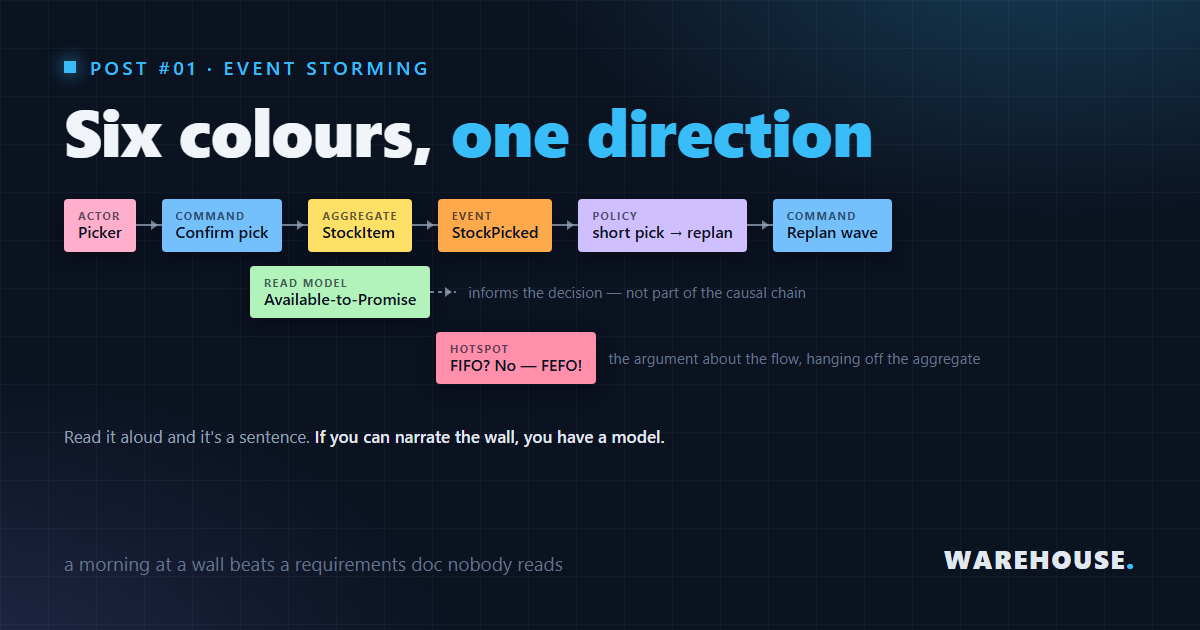
The genius of the method is a tiny visual grammar. Each colour is a different kind of thing, and they snap together in a predictable way. This is the exact legend used on every board and diagram in this series:
| Colour | Means | In our domain |
|---|---|---|
| 🟧 orange | Domain event — a fact, past tense | GoodsReceiptConfirmed, StockReserved, ShipmentDispatched |
| 🟦 blue | Command — an intent that causes an event | Confirm goods receipt, Release wave to floor |
| 🟨 yellow | Aggregate — the thing that decides whether a command is allowed | StockItem, Batch, OutboundOrder |
| 🟪 purple | Policy — “whenever this event, then that command“ | “blocked batch → quarantine its stock everywhere” |
| 🟩 green | Read model — the view someone looks at before deciding | “Available-to-Promise view”, “Pick list (routed)” |
| 🟥 pink | Actor / external system — who issues the command | Supplier, Picker, Carrier, ERP |
| 🩷 hot pink | Hotspot — a question, a conflict, an insight | “FIFO? No — FEFO!” |
They assemble into one repeating sentence, left to right in business time. An actor (pink) issues a command (blue); that command hits an aggregate (yellow), which decides whether it’s allowed and emits a domain event (orange). A read model (green) feeds into the command with a dotted “informs” arrow — it’s what the actor consulted before deciding, not part of the causal chain itself. The event then flows into a policy (purple), which in turn triggers the next command, and the sentence begins again. Off to the side, a hotspot (hot pink) hangs off the aggregate on a dotted line — it isn’t part of the flow, it’s the argument about the flow.
Read it aloud and it’s plain language: “a Picker issues Confirm pick; the StockItem decides it’s allowed and emits StockPicked; whenever a short pick happens, the short-pick policy triggers a replan.” When you can narrate the wall like a story, you have a model. When you can’t, you’ve found a hotspot.
Two kinds of sticky are worth more than the rest
- Pivotal events. A few orange stickies are clearly more important than the others — the ones every process funnels through. On our board they were
GoodsReceiptConfirmed,StockReservedandShipmentDispatched. These are gold: they’re the natural seams between services (the three services we carve later meet exactly there) and the natural integration events later. We mark them ⚡ on the boards. - Hotspots. The hot-pink stickies are not noise to clean up — they’re the most valuable thing on the wall. “QC blocks the batch, not the pallet.” “Never edit stock — add a correction.” Every one is a place the naive model was wrong. We kept them on the board on purpose; sanding them off would throw away the reason the model looks the way it does.
Zoom in one level at a time
Brandolini’s method runs at three magnifications. We used all three, and each produced a board we kept.
1 · Big Picture — the whole business in one glance
The kickoff. Wide, chaotic, the entire flow of goods left to right in business time, every actor and external system, every hotspot. The goal isn’t precision — it’s scope and shared language. You’re answering “what happens here, and where are the surprises?”
The big-picture board holds five phases (inbound → quality → storage → outbound → stocktake), a deployment band that groups five contexts into three services, and all nine corrections pinned where they happened.
2 · Process Level — one flow, with its unhappy paths
Now zoom into a single process and use the full grammar: commands, the aggregates that decide, the policies that chain steps, the read models people consult — and the exception paths, which is where real systems are won or lost. You’re answering “how does this one flow actually work when things go sideways?”
The outbound process board covers order fulfilment end to end. It’s the outbound story made mechanical — the two-stage soft reserve → hard FEFO allocation, plus the branches we’d otherwise forget: ATP-insufficient backorders, a batch that gets quarantined between reservation and allocation, and the short-pick replan loop.
3 · Design Level — inside one aggregate, the last stop before code
The tightest zoom: a single aggregate, its commands in, its events out, and — the part that becomes code almost verbatim — its invariants. You’re answering “what is this thing allowed to do, and what must always be true?”
The design board draws the StockItem boundary: commands on the left, events on the right, the invariants in the middle (OnHand ≥ 0, allocate ≤ available, unit-safe quantities, “every behaviour returns a ledger entry”), the append-only StockMovement it projects from, and the policies that don’t fit inside it (capacity spans many items; FEFO spans StockItem and Batch) standing deliberately outside the boundary. That last distinction is a whole archetype — which is exactly where this series goes next.
What a session actually looks like
Less mystical than it sounds. Ours ran one morning, roughly:
- Unstructured exploration (the longest part) — everyone throws orange events at the wall, no order, no filtering. Duplicates and contradictions are fine right now.
- Enforce the timeline — sort events left to right in business time. Gaps appear: “wait, what happens between DeliveryArrived and StockReceived?” (Answer: the dock buffer. We’d have missed it.)
- Add the grammar — who triggers each event (actors/commands), what decides (aggregates), what chains steps (policies), what people look at (read models).
- Hunt hotspots — wherever the room argues, slap a pink sticky. Don’t resolve it on the spot; mark it and move on, or you’ll rat-hole for an hour.
The other non-negotiable is who’s in the room. A session without the people who actually do the work is just developers guessing in colour. Ours had a warehouse manager, a logistics coordinator, a QC lead and an auditor next to the developers and the product owner — and every single correction came from their side of the table, not ours. In one moment a developer proposed a Suppliers table and got it demolished in real time. That demolition is the ROI.
Trade-off — it’s a workshop, not a document generator. Event Storming buys you shared understanding and early correction, but it costs the calendars of your busiest domain experts for half a day, a facilitator who can keep eight opinions moving without bulldozing them, and the discipline to treat the board as disposable. Skip the real experts and you get a confident, beautifully-coloured wall that is wrong. The board is also not your documentation — it’s a snapshot of a conversation; the durable artifacts are the ubiquitous language, the model, and the diagrams that outlive the session.
Trade-off — remote dulls it. The method’s superpower is eight people standing at a wall moving paper at once. On a digital canvas you keep the artifact (and versioning — that’s why ours are generated and committed), but you lose some of the parallel, physical, interrupt-driven energy that surfaces the best arguments. We accept it because committed, diffable boards are worth more to a distributed team than the extra few hotspots a physical wall might have caught.
What our morning actually produced
Concretely, by lunch we had:
- a ubiquitous language the whole team now shares (ASN/awizacja, dock buffer, FEFO, LPN, blind count, available-to-promise) — the glossary that follows is just this, written down;
- the aggregates that became our code (
StockItem,Batch,InboundDelivery,OutboundOrder,StockMovement, …); - the service seams, handed to us for free by the pivotal events;
- and nine corrections that each deleted a plausible-but-wrong design before it was built.
Not bad for a wall, some paper, and the discipline to ask the people who drive the forklifts.
What’s next
Next we point the technique at a real domain: why a warehouse, why domain-first instead of docker compose up, and the big-picture board in full — the strategic decisions it surfaced (microservices from day one, stock as an append-only ledger) and the price tag on each. The method you just met, applied — and corrected — in anger.
Bibliography
- Alberto Brandolini — Introducing EventStorming (Leanpub) — the book by the method’s inventor; see also eventstorming.com
- Martin Fowler — “EventStorming” — his write-up of the workshop format and where it fits in modelling (martinfowler.com/bliki/EventStorming.html)
- Eric Evans — Domain-Driven Design: Tackling Complexity in the Heart of Software (Addison-Wesley) — the origin of the Ubiquitous Language that Event Storming builds on the wall

Leave a Reply