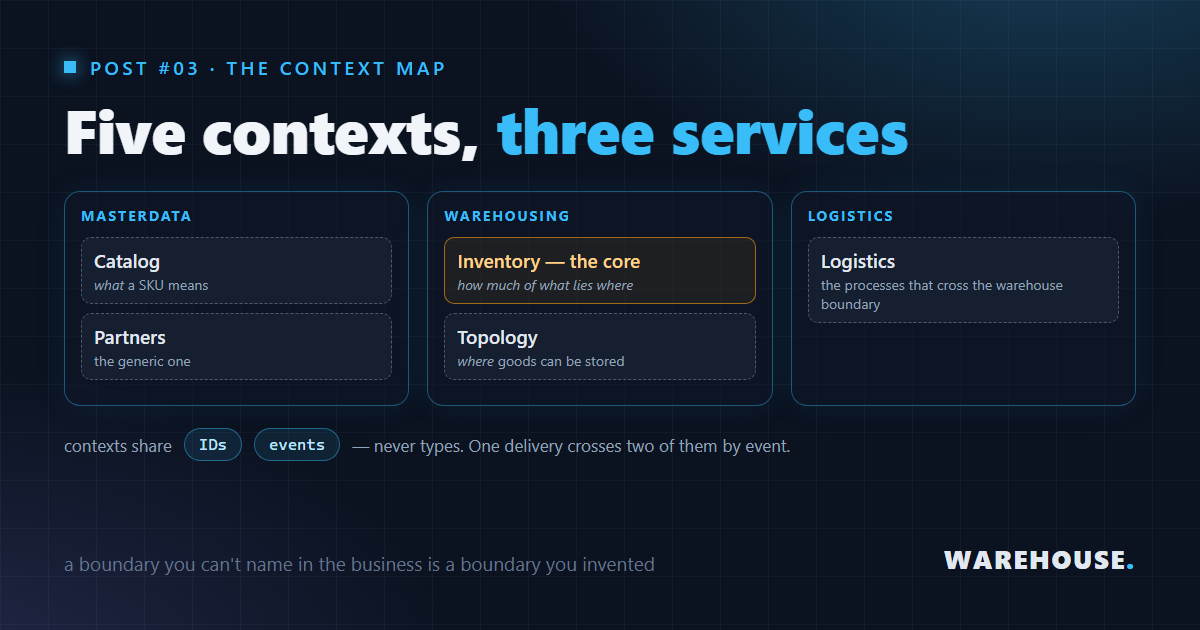
Early in this project we carved the warehouse domain into five bounded contexts deployed as three services — that split is the ground we’re standing on today. Now we walk through each context: what it owns, which use cases it serves, and — the part most tutorials skip — exactly how contexts talk to each other without sharing a single type.
One reading note: each context below has a “Domain flavor” box written with the developer glasses off — the yogurt-and-forklift version of the same rules. If a box surprises you, good: most of them record something the business corrected us on. DDD is not the diagrams; it’s the fact that we now know why milk is shipped by the date on the lid, not the day it arrived.
The context map
The whole system fits on one map — two core contexts, two supporting, one generic:
Read the arrows carefully: solid arrows are event flow — one context publishing facts the other reacts to — while dotted lines are a shared convention (a code format, a reference by value), never a shared type. Catalog’s strict Sku, Inventory’s lighter Sku and Logistics’ loose ProductCode are three different types that agree on a format; more on why when the series reaches the shared kernel.
Catalog — what a SKU means
The product card: name, EAN, dimensions, weight, category, storage requirements (temperature range, cold chain, hazmat), batch/expiry flags, and per-product unit conversions (for this SKU, 1 pallet = 48 pieces; for another, 24).
- Aggregate:
ProductType(identified by its natural key, the SKU) - Use cases: UC-13 Manage products
- Knows nothing about stock or locations — by design. A product card saying “stored in WAW1” would be the first crack in the boundaries.
The interesting rule: changing storage requirements does not move existing stock. The system reports incompatibilities; a human decides. Automating that decision would mean the catalog silently triggering forklift work — a category error.
🧀 Domain flavor: when a producer reformulates a cheese and it suddenly needs 2–6 °C instead of ambient, three pallets of it are already sitting in the dry hall. The product manager edits the card; the warehouse manager gets a report saying “WAW1: 3 pallets now in the wrong room” and decides when a forklift deals with it — between trucks, not in the middle of the morning rush. The catalog states requirements; it never drives forklifts. Same with conversions: “a pallet” is not a unit of measure, it’s a per-product fact — 48 crates of yogurt, 24 boxes of detergent. Ask a supplier how much fits on a pallet and the answer is always “of what?” — and sometimes even “depends on the truck”. The same yogurt rides 48-to-a-pallet on an industrial pallet and 36 on a euro-pallet. So the catalog conversion is only the default; the authoritative count can belong to the specific delivery (the inbound line carries its own pack). Pinning that knowledge to master data alone would quietly miscount every receipt that arrived stacked differently.
Topology — where goods can be stored
Physical structure: WarehouseSite → Room (standard / cold room / freezer / hazmat, each with a maintained RoomEnvironment) → Location (addressable rack/shelf with capacity and load limit) plus Docks.
- Use cases: UC-14 Manage topology
- Location codes (
WAW1-CHLD1-A-03-2) are stable, scannable physical addresses — they end up as barcodes on racks, which is why they are natural keys, not GUIDs.
🏷️ Domain flavor: read the code aloud and you can walk there: warehouse WAW1, cold room CHLD1, aisle A, rack 03, shelf 2 — a street address for goods. The label is printed once and glued to steel; if codes were database GUIDs, every re-labeling project would cost a weekend and a laminator. One special location kind is the dock buffer: the marked square of floor by the ramp where received goods legally exist (“on stock”) before anyone decides where they’ll live. Without it, you can’t answer the auditor’s favorite question: “the truck left at 7:00, put-away finished at 9:00 — where was the butter at 8:00?”
Trade-off: one aggregate per warehouse keeps structural rules (unique codes, environment-per-room-type) trivially consistent, but a warehouse with 10k locations makes it a big aggregate. Fine for master data that changes rarely; we documented it as a known refactoring point rather than pre-optimizing.
Inventory — the core: how much of what lies where
StockItem— quantity of one SKU+batch at one location; hard allocations live inside itStockReservation— the soft promise made at order time (SKU-level, no pallet pinned)StockMovement— the append-only ledgerBatch— expiry (FEFO) and the QC hold: blocking a batch hides it everywhere at onceHandlingUnit— pallets/cartons with a scannable LPN; one scan moves the whole palletStocktake— blind counts, differences become ledger adjustments- Domain services:
PutAwayPolicy(the hard temperature/capacity rule),StockTransferService(one move = one ledger entry across two stock items),ReservationService(the soft-reserve gate) andAllocationPolicy(the hard-allocate gate — see below) - Use cases: UC-05…UC-08 (stock view, moves, stocktake, adjustments)
Two stages, not one — soft reservation then hard allocation. This is the correction a warehouse veteran insisted on, and it matters. When the order arrives, we take a soft reservation: “300 of this SKU, in this warehouse, spoken for.” It protects the promise without pinning a pallet. The concrete pin — which batch, which location — is a separate step, hard allocation, done at wave/pick time. Why split them? Because pinning a pallet two days early means re-pinning it every time that pallet is blocked, damaged or moved; the soft reservation lets the physical stock stay fluid until the last responsible moment.
The numbers a manager actually reads. For each SKU+warehouse the system distinguishes OnHand (physically on shelves), Allocated (hard-pinned to orders, awaiting pick), and available-to-promise = on hand − allocated − outstanding soft reservations. The shelf holds 12 yogurts, 8 are already spoken for → a new order can take at most 4. Selling the same yogurt twice is the unforgivable sin of warehousing, and this subtraction is the whole defense.
The allocation gate. Hard allocation runs at wave/pick time, and AllocationPolicy is the bouncer: it refuses to commit a batch that is in quarantine (QC still deciding), rejected (QC said no), or expired. The timing is the point — a batch can be fine when the order is placed and blocked two days later, so the gate fires when stock is committed, not when it’s promised. And because a batch can be blocked after its stock is already sitting in five locations, the BatchBlocked event sweeps through and quarantines those stock items too — the rule holds at the gate and converges afterwards.
🥛 Domain flavor — why FEFO and not FIFO: Monday’s delivery of milk can carry a shorter expiry than the milk already on the rack (different production line, different dairy). First-in-first-out would ship the older delivery — and let the sooner-expiring stock quietly rot in row B. First-expired-first-out ships what dies first. The warehouse manager’s phrasing: “we don’t sell milk, we sell time until the date on the lid“.
Logistics — the processes that cross the warehouse boundary
Four state machines: InboundDelivery (ASN → arrival → receipt → put-away), OutboundOrder (created → reserved → picking → packed → dispatched), PickList (routed tasks, short-pick handling), Shipment (packages, carrier, tracking).
- Use cases: UC-01…UC-04 (inbound), UC-09…UC-12 (outbound)
- Logistics holds process state; physical stock truth stays in Inventory. A pick list does not decrement anything — confirming a pick does, in Inventory, via a command.
🚚 Domain flavor: two rules here came straight from the receiving dock. First: only announced deliveries get received — an unannounced truck means an ad-hoc ASN is created first, then receiving starts. Sounds bureaucratic, until you learn that ramps are a scarce resource booked in time windows (a dock slot), and an unplanned 18-wheeler blocks four planned ones. Second: when the operator confirms a receipt, lines nobody scanned become full shortages automatically — the driver who “forgot” a pallet of butter doesn’t get the benefit of an ambiguous paper trail. And on the way out: a picker who finds 11 where the system promised 12 reports a short pick — she never “fixes” the number herself. The missing yogurt is a stocktake problem, not a picking problem; mixing those two responsibilities is how warehouses lose track of what’s true.
Partners — the generic one
Party + roles (SupplierRole, CustomerRole, CarrierRole). One company can be both our supplier and our customer — same party, two roles, never two duplicate roles. A textbook archetype, and exactly the kind of subdomain where you want boring code.
🤝 Domain flavor: the sentence that designed this context was the PO’s offhand “half our suppliers also buy from us” — a dairy delivers yogurt on Monday and buys back near-expiry stock for its outlet store on Friday. Model that as two tables and you get two addresses, two tax IDs, and an accountant asking why “Mlekpol Sp. z o.o.” owes itself money. One party, two roles — and the roles carry their own data: the customer role has shipping addresses, the carrier role has service levels (can they even haul refrigerated?).
The use cases, mapped to actors
Here is the full use-case inventory, mapped to the people (and systems) who trigger each one:
Customer / ERPWho drives what: each actor mapped to the use cases they trigger.
Notice the two very different user experiences hiding here: managers and coordinators get a classic admin panel; operators get a scanner-first terminal with three giant buttons. Same domain, two frontends — that distinction will drive the React work later in the series.
How a delivery actually flows across contexts
One sequence shows the inbound flow crossing the Logistics–Inventory boundary, from ASN to put-away:
And the outbound mirror image: order → soft StockReservation (protects available-to-promise) → at wave time AllocationPolicy pins concrete stock (FEFO, batch quality re-checked) → routed pick list → scans decrement stock → packed → ShipmentDispatched.
The rules of conversation between contexts
This table is the contract that keeps the system decoupled — worth printing:
| Mechanism | Used for | Examples |
|---|---|---|
| Integration events (async, via outbox) | Facts other contexts react to | ProductDefined → snapshot; GoodsReceiptConfirmed → stock enters dock buffer |
| Shared conventions (code formats, refs by value) | Pointing at things another context owns | a SKU code (Catalog Sku / Inventory Sku / Logistics ProductCode), PartyRoleRef, WarehouseRef, OrderRef on an allocation |
| Local replicas | Data needed to enforce my invariants | Inventory’s ProductSnapshot, LocationSnapshot |
| Never | — | sharing entity types, querying another service’s DB, synchronous calls inside invariant checks |
Trade-off: duplication.
LocationCodeexists in Topology and (as its own type) in Inventory; storage requirements exist in Catalog and again in the snapshot; even a SKU is three types (Catalog’s strict one, Inventory’s lighter one, Logistics’ looseProductCode). That is deliberate: each context evolves its copy independently, and the only thing they truly share is the language (the code format). Sharing types would be less typing today and a distributed monolith tomorrow.
What’s next
Next up: before the patterns, the single most consequential tactical decision — the aggregate boundary. We listed our aggregates casually above; the next post is about how you actually draw those lines, why StockItem is tiny and WarehouseSite is big, and what it costs to get the boundary wrong. After that: the archetype patterns behind these models — why Party/Role instead of a Supplier table, why quantities always carry units, and why the yellow stickies ended up as our most important code.
Bibliography
- Eric Evans, Domain-Driven Design: Tackling Complexity in the Heart of Software — the original source of the Bounded Context, the Context Map, and the Anti-Corruption Layer this post’s map is drawn in.
- Vaughn Vernon, Implementing Domain-Driven Design — the practical treatment of context mapping and integrating bounded contexts with events, values, and replicas rather than shared types.
- Scott Millett & Nick Tune, Patterns, Principles, and Practices of Domain-Driven Design — a thorough walkthrough of subdomain classification (core, supporting, generic) and the integration patterns between contexts.


Leave a Reply