Part 4 in the series on building a real microservices warehouse application. Start from the beginning: How Microservices Are Really Built.
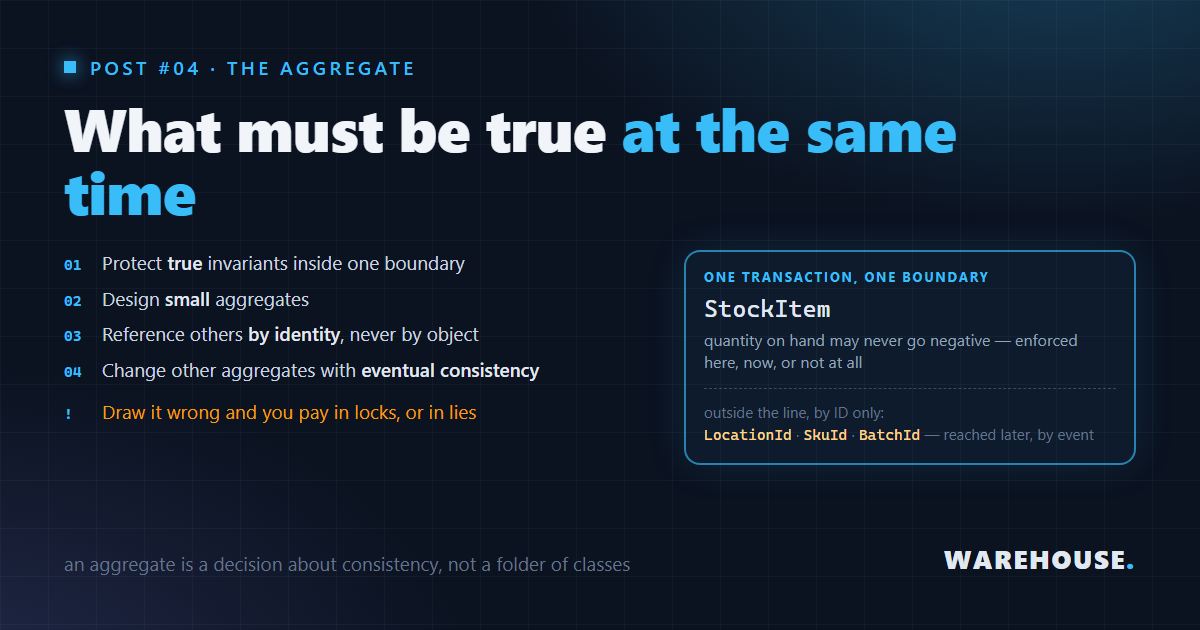
Once you’ve split a domain into services and named the objects that live inside them — StockItem, Batch, WarehouseSite, OutboundOrder — it’s tempting to think the hard part is over. It isn’t. The hard part is the line you draw around each one: what’s inside, what’s outside, and what is allowed to change in a single breath. Get that line right and the model almost writes itself. Get it wrong and you spend the next year fighting deadlocks, “why is this row always locked”, and bugs where two users overwrite each other and the auditor’s numbers stop adding up.
This is the single most consequential tactical decision in DDD, and it deserves its own post. You may have met the one-line definition before (“an aggregate is the consistency boundary”). Here we earn it: what the boundary really is, the four rules for drawing it, how to find it in a real domain, and a tour of every line we drew in the warehouse — including the one we deliberately drew small and the one we deliberately drew big.
What an aggregate actually is
Three definitions, from least to most useful:
- Textbook: a cluster of entities and value objects treated as a single unit, with one aggregate root as the only entry point.
- Practical: the consistency boundary — the set of objects that must obey their invariants together, in one transaction.
- Operational: the unit you load and save as a whole. One aggregate, one repository, one transaction, one lock.
The root is just the entity that owns the boundary. Everything outside reaches in through the root and never touches the insides directly. In code, the root is the only thing that carries domain events and the only thing a repository hands you:
// SharedKernel — every root is exactly this much machinery, no more.
public abstract class AggregateRoot<TId> : Entity<TId>
    where TId : notnull
{
    private readonly List<IDomainEvent> _domainEvents = [];

    protected void Raise(IDomainEvent domainEvent) => _domainEvents.Add(domainEvent);

    // Infrastructure dequeues after a successful save and feeds the outbox.
    public IReadOnlyList<IDomainEvent> DequeueDomainEvents() { ... }
}
Simplified from the warehouse’s shared kernel base class.
That’s the whole base class. The aggregate’s value isn’t in the base type — it’s in the boundary you choose. So let’s talk about choosing it.
The four rules (and the warehouse evidence for each)
These are Vaughn Vernon’s “Effective Aggregate Design” rules, distilled. Every one of them left a fingerprint on this codebase.
Rule 1 — Protect true invariants inside one boundary
An aggregate exists to keep an invariant true. If two pieces of data must always agree — agree at every instant, with no window where they’re inconsistent — they belong in the same boundary. If they’re allowed to be briefly out of step, they don’t.
The StockItem boundary exists for one invariant: you can never allocate more than you have. Allocated ≤ OnHand, always, no exceptions, no “fix it next batch job”. That rule is enforced by the root, in one transaction, before the change is allowed to exist:
public Allocation Allocate(Quantity quantity, OrderRef orderRef, StockReservationId reservationId)
{
    if (Status != StockStatus.Available)
        throw new DomainException("stock_not_available", ...);

    if (!Available.IsGreaterThanOrEqualTo(quantity))   // Available = OnHand − Allocated
        throw new DomainException("stock_insufficient", ...);

    var allocation = new Allocation(AllocationId.New(), reservationId, orderRef, quantity);
    _allocations.Add(allocation);
    Allocated = Allocated.Add(quantity);
    Raise(new StockAllocated(...));
    return allocation;
}
Simplified from the warehouse Inventory aggregate’s allocation method.
Selling the same yogurt twice is the unforgivable sin of warehousing, and this subtraction is the whole defense. It works because the allocations live inside the boundary — the root can sum them and compare against on-hand atomically.
🥛 Domain flavor: “true invariant” has a test. Ask the warehouse manager: “is it ever, even for a second, OK for allocated to exceed on-hand?” The answer is a flat no — so it’s a true invariant and goes inside the boundary. Ask “is it OK if the stock-levels dashboard is three seconds behind reality?” — “sure, it’s a dashboard” — so that does not go inside; it’s a read model fed by events.
Rule 2 — Design small aggregates
The instinct of a beginner is the big aggregate: a Warehouse that owns its rooms, which own their locations, which own the stock on them. It feels tidy — one object, the whole truth. It is a trap. Every forklift confirmation would load and lock the entire warehouse; forty operators would serialise behind one row; the object would be megabytes.
So our core aggregate is deliberately tiny — the quantity of one SKU + batch at one location — and we said so in the class itself:
/// The Inventory archetype entry and our core aggregate: quantity of one SKU (and batch)
/// at one location. Deliberately small — every scan gun confirmation is a transaction on
/// a single StockItem, so there are no hot rows.
public sealed class StockItem : AggregateRoot<StockItemId>
Simplified from the warehouse Inventory aggregate’s class declaration.
This is the clearest example of the rule paying off: a scan is a short transaction on a single small row, so 40 concurrent forklifts never contend.
Trade-off: small aggregates can’t enforce invariants that span them. “Total volume in this location across all SKUs must not exceed capacity” touches many
StockItems, so no single one can own it. We pay for small aggregates by pushing that rule into a domain service (PutAwayPolicy) backed by a database constraint as the last line of defense. That’s the deal: small aggregates buy concurrency, and the bill is “cross-aggregate rules move outside”.
Rule 3 — Reference other aggregates by identity, never by object
Inside a boundary you hold real objects. Across boundaries you hold only IDs (or a value reference). An Allocation needs to know which order it serves and which soft reservation it came from — but OutboundOrder and StockReservation are other aggregates, so it holds references, not pointers:
public sealed class Allocation : Entity<AllocationId>   // lives INSIDE StockItem
{
    public StockReservationId ReservationId { get; private set; }  // → another aggregate, by id
    public OrderRef OrderRef { get; private set; }                 // → an order in Logistics, by value
    public Quantity Quantity { get; private set; }
    public AllocationStatus Status { get; private set; }
}
Simplified from the warehouse Inventory aggregate’s allocation entity.
Why so strict? Because an object reference is an invitation to load and modify the other aggregate in the same transaction — and the moment you do, you’ve silently merged two boundaries into one giant transaction and one giant lock. An ID can’t be accidentally mutated. It forces the question “do these really change together?” to be answered honestly, in the open. (Note OrderRef is a reference to something a different bounded context owns; it can only ever be a value — contexts talk to each other through ids and events, never shared objects.)
Rule 4 — Change other aggregates with eventual consistency
If a single user action must change two aggregates, the default is not one transaction that locks both. The default is: change one now, raise a domain event, let the other catch up.
The warehouse’s sharpest example is the QC hold. A Batch and a StockItem are separate aggregates (a batch is suspicious everywhere at once; stock is per-location). When QC blocks a batch, every stock item of that batch — in every location, in every warehouse — must become unavailable. You cannot do that in one transaction without locking the whole world. So you don’t.
Each stock item flips in its own little transaction. For a few milliseconds the batch is blocked but a stock item hasn’t caught up yet — and that’s fine, because the allocation gate re-checks batch quality at the moment of allocation anyway (the AllocationPolicy). The rule holds at the gate and converges afterwards. The window is acceptable; the alternative (one transaction across thousands of rows) is not.
Trade-off: eventual consistency between aggregates means you must answer “what happens in the gap?” for every cross-aggregate rule. We answer it twice — a converging sweep plus a gate that re-validates — which is more code than a single big transaction. We buy something worth far more: the system stays responsive, and no operation ever locks more than one small row.
How to actually find the boundary
Rules are easy to recite and hard to apply. Here’s the procedure we used, in order:
- List the invariants first, aggregates second. Don’t start from nouns (“there’s clearly a
Warehouseclass”). Start from rules that must never be violated, then draw the smallest boundary that makes each rule enforceable in one transaction.Allocated ≤ OnHandgave usStockItem. Unique room/location codes gave usWarehouseSite. The invariant is the aggregate’s reason to exist. - Apply the “one transaction” test. If completing a use case forces you to modify two candidate aggregates atomically, either they’re really one aggregate, or your boundary is wrong, or (usually) the second change should be eventually consistent via an event. Three answers — pick deliberately, don’t drift into a two-aggregate transaction by accident.
- Apply the “delete” test. What gets deleted together? Delete a
Partyand its roles go with it — roles have no life of their own, so they’re inside. Delete aStockReservationand the orders it referenced absolutely do not vanish — so orders are outside. - Apply the “true vs convenient” test. “Allocated never exceeds on-hand” is true consistency. “I’d like the dashboard to match instantly” is convenient consistency. Only true consistency justifies a boundary; convenient consistency is what read models and events are for.
- Default to smaller; merge only under proof. Start with the smallest boundary the invariants allow. Only grow it when a concrete invariant forces two things into the same transaction. A boundary that’s too small costs you an event; a boundary that’s too big costs you concurrency, and concurrency is the more expensive bug.
A useful sanity check at the end: one aggregate ↔ one repository ↔ one transaction. If you catch yourself wanting a repository that returns half an aggregate, or a transaction that saves two, the line is in the wrong place.
The lines we drew (a tour)
It helps to picture the whole map at once. At the center sits the StockItem aggregate, drawn tiny, with two things held inside its boundary: its Allocation entities and its OnHand/Allocated value objects. Around it sit four other aggregates it never contains, only points at: Batch, StockReservation, OutboundOrder (which lives in the Logistics context), and the big master-data WarehouseSite.
The distinction that matters is the kind of line. Containment inside the aggregate — the Allocations and quantities that live within StockItem — is drawn with solid lines: these objects are part of the boundary, loaded and saved as one unit. Every crossing to another aggregate is drawn with a dotted line, meaning “reference by id or value, never containment”: Allocation points to its StockReservation by ReservationId and to its order by the cross-context OrderRef value; StockItem points at its Batch by a Sku + BatchNumber value and at its location by a LocationCode value. Read the map that way — solid means inside, dotted means across — and you can see every one of the four rules at work.
StockItem— drawn small, on purpose. Holds itsAllocations (entities) and its on-hand/allocated quantities (value objects) inside, becauseAllocated ≤ OnHandis a true invariant. Everything else it merely references. The whole class is a few hundred lines and every method is a short transaction.Allocation— an entity, not an aggregate. It has identity and lifecycle (Active → Fulfilled / Released) but no independent existence: an allocation without its stock item is nonsense. So it lives insideStockItem, mutated only through the root, withinternalmethods (ReduceBy,MarkFulfilled) the outside world can’t call. Thatinternalkeyword is the boundary, enforced by the compiler.Batch— a separate aggregate, referenced by value.StockItemknows its batch as aBatchNumbervalue, not aBatchobject, precisely because the QC hold must propagate by event (rule 4), not by reaching across and mutating in one transaction.WarehouseSite— drawn big, also on purpose. The counter-example that proves rules aren’t dogma. A warehouse owns its rooms, docks and locations as a single aggregate, because structural invariants (unique codes, environment-per-room-type) are simple, must be consistent, and the data changes rarely — it’s master data, edited by a manager between trucks, never under forklift concurrency:public Location AddLocation(RoomCode roomCode, LocationCode code, ...) { if (_rooms.SelectMany(r => r.Locations).Any(l => l.Code == code)) throw new DomainException("location_code_duplicate", ...); // invariant across the whole site ... }Simplified from the warehouse Topology aggregate’s site-structure method.Trade-off: one aggregate per warehouse means a site with 10k locations is a big object to load. We accept it because the access pattern is rare reads and rarer writes — the exact opposite ofStockItem. Same domain, opposite decisions, and the deciding factor in both cases was the same question: does this change under concurrency? We documented the large-aggregate risk explicitly rather than pre-optimising. The size rule is “small by default“, not “small always“.
Smells that mean the line is wrong
A field guide to aggregate mistakes — every one of these we either avoided or caught in review:
- The God Aggregate.
Warehouseowns all stock. Symptom: one row everyone locks; “why is the warehouse always busy?”. Fix: find the real per-operation invariant and shrink to it. - The Anemic Aggregate. A root with public setters and no behavior; rules live in handlers outside. Symptom: the same validation copy-pasted across three services, one of which forgot it. Fix: push the invariant into the root (see
Allocateabove — you literally cannot over-allocate). - The Object-Reference Leak. An aggregate holds a
Batchinstead of aBatchNumber. Symptom: a use case quietly saves two aggregates in one transaction. Fix: hold the id; let the change be eventually consistent. - The Multi-Aggregate Transaction. “Place order” updates the order and decrements five stock items atomically. Symptom: deadlocks under load, distributed-transaction temptation. Fix: one aggregate per transaction; the rest follows by event.
- The Convenience Boundary. Two things share an aggregate only because it’s handy to load them together. Symptom: a “true invariant” nobody can name. Fix: that’s a read model, not an aggregate.
The one paragraph to remember
An aggregate is not a data structure; it’s a decision about what must be true at the same time. Draw the boundary around the invariant, keep it as small as that invariant allows, reference everything else by id, and let the rest of the world catch up through events. When you’re unsure, ask the domain expert the only question that matters — “can these two facts ever, even for a second, disagree?” — and let the answer draw the line for you.
What’s next
Next up: the archetype patterns behind these aggregates — why Party/Role instead of a Supplier table, why quantities always carry units, why the ledger is a Moment-Interval, and the pre-paid price tag attached to each pattern.
Bibliography
- Vaughn Vernon, Effective Aggregate Design — the three-part essay this post distills into its four rules; the canonical argument for small aggregates and referencing others by identity.
- Eric Evans, Domain-Driven Design: Tackling Complexity in the Heart of Software — the original source of the aggregate, aggregate root, and consistency-boundary concepts.
- Vaughn Vernon, Implementing Domain-Driven Design — the practical companion that works aggregates, domain events, and eventual consistency into running code.

Leave a Reply